 Save
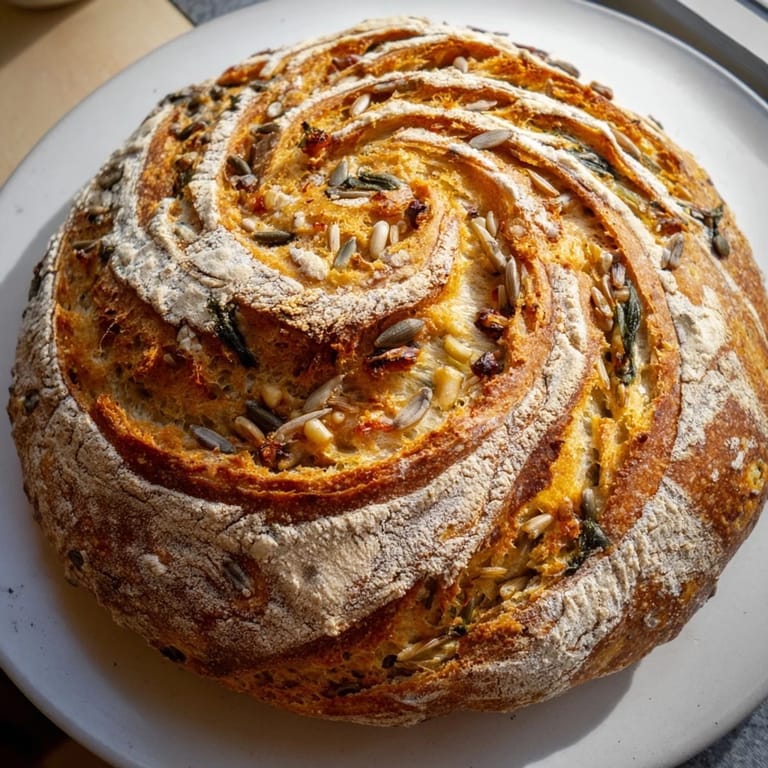
Save I'll never forget the afternoon I discovered the Fibonacci spiral in nature while sitting in my grandmother's garden. A sunflower caught my eye, its seeds arranged in that perfect mathematical dance, and I thought: what if I could bake this? Years later, standing in my kitchen with flour dust catching the light, I created this bread—each spiral segment a story, each ingredient a layer of intention. This isn't just a loaf; it's edible geometry that tastes as beautiful as it looks.
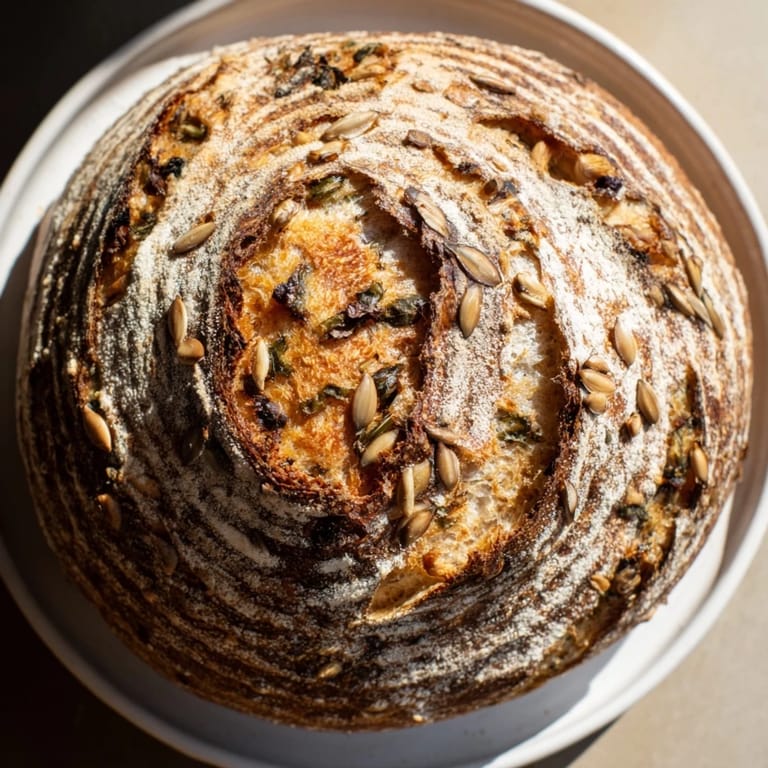
The first time I made this for friends, I sliced it at the table and watched their faces light up as they saw the spiraling pattern of colors and textures revealed inside. One bite told the whole story—sunflower sweetness giving way to walnut earthiness, then the sharpness of cheese and the tangy brightness of sun-dried tomatoes. That's when I knew this bread was more than just technical; it was magic.
Ingredients
- 500 g strong bread flour: The backbone of your spiral. Strong flour gives you the elasticity you need to build those seven perfect dough portions without tearing. I learned to weigh it, not measure by cup—the difference between success and dense bread is real.
- 350 ml lukewarm water: This is your hydration lifeline. Lukewarm means it wakes up your yeast or starter gently, like a friend you're inviting into a long conversation.
- 100 g active sourdough starter or 7 g instant yeast: Use sourdough if you have it—the slow fermentation creates this incredible depth. If you're using yeast, instant works faster and gives you more control over timing.
- 10 g fine sea salt: Don't skip this or rush it in. Salt strengthens gluten and brings out every flavor layer in your spiral additions.
- 15 ml olive oil: Just enough to keep the dough supple without making it greasy. Good olive oil whispers in the background.
- 20 g toasted sunflower seeds: Toast them yourself if you can—that nutty warmth makes all the difference. This is your spiral's gentle beginning.
- 30 g chopped walnuts: Rich and earthy, they anchor the second spiral with substance.
- 40 g pumpkin seeds: These bring a slight pepperiness that wakes up your palate.
- 50 g grated hard cheese (Gruyère or Parmesan): Gruyère is my go-to because it melts slightly into the dough and creates little pockets of flavor. Parmesan if you want something sharper.
- 60 g chopped sun-dried tomatoes, drained: Drain them well, or your dough gets wet and unpredictable. They're concentrated flavor bombs.
- 70 g mixed olives, pitted and chopped: This is where brininess enters the spiral. I use a mix of Kalamata and Castelvetrano for complexity.
- 80 g sautéed spinach, well-drained: Sauté it in a dry pan until it releases all its moisture, then squeeze it in a clean kitchen towel. This is non-negotiable—wet spinach ruins everything.
Tired of Takeout? 🥡
Get 10 meals you can make faster than delivery arrives. Seriously.
One email. No spam. Unsubscribe anytime.
Instructions
- Start with the autolyse—let flour and water get acquainted:
- Mix your flour and lukewarm water together until there are no dry pockets. It'll be shaggy and rough, like you're meeting a new friend. Cover it and walk away for 30 minutes. This rest is magic—it lets the flour hydrate fully, which means less kneading later and better flavor development.
- Bring in your leavening and build the dough:
- Add your sourdough starter (or yeast), salt, and olive oil to the rested dough. Mix until everything combines into a sticky, unified mass. Now knead on a lightly floured surface for 8 to 10 minutes. You're looking for smooth, elastic dough that springs back when you poke it. Your hands will tell you when it's ready—it'll feel alive.
- Let time do the heavy lifting during the long rise:
- Place your dough in an oiled bowl, cover loosely, and let it rest at room temperature for 8 to 12 hours. Sourdough teaches you patience. If you're using instant yeast, check at 4 to 5 hours. You want the dough to roughly double, with visible bubbles breaking the surface. This slow fermentation is what makes every layer sing.
- Divide and conquer with seven portions:
- Turn your risen dough onto a floured surface. Using a bench scraper, divide it into seven equal portions. I cut from the center outward, like slicing pie, to keep each piece roughly the same size. Handle them gently—you've earned all those bubbles.
- Layer in the Fibonacci story, starting small:
- Take your first portion and gently knead in the 20 g of toasted sunflower seeds. Work slowly, letting them distribute evenly throughout. Then move to the next portion with 30 g walnuts, then 40 g pumpkin seeds, continuing up to 80 g spinach for the final, largest piece. Each addition feels like you're building a narrative—delicate to bold, subtle to assertive.
- Shape each portion into a rope and spiral them together:
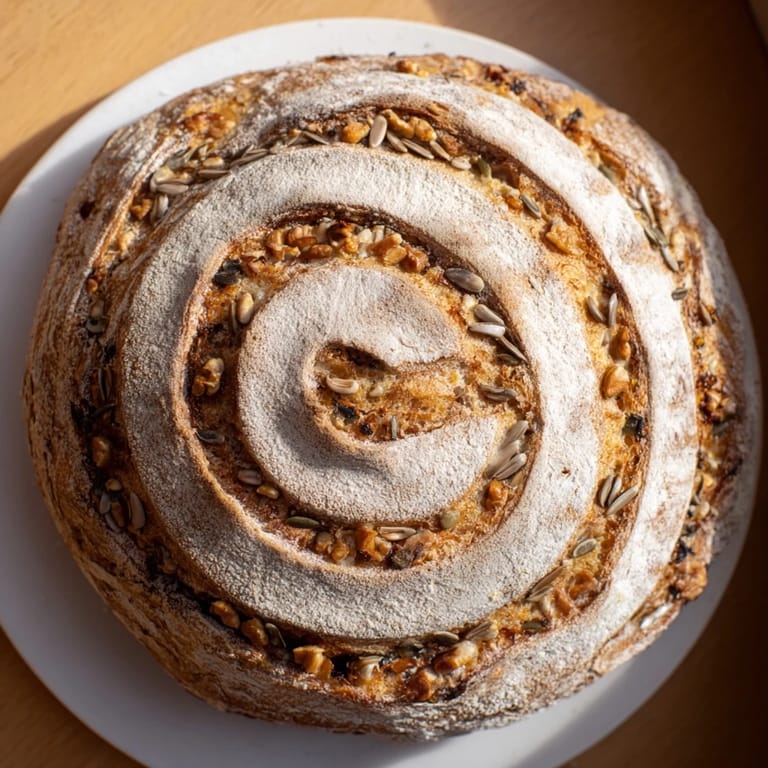
- Roll each portion into a long rope, roughly 20 cm to 25 cm, depending on how tightly you want the spiral. Start with your smallest rope (the sunflower seed one) and coil it at the center of a parchment-lined baking sheet. Now, take the next rope and wrap it around the first, then the next, spiraling outward. As you build, you'll see your Fibonacci sequence come to life—each ring bigger, each one a different flavor. Press the ends together gently to seal.
- Give it a final rise until it's proud and puffy:
- Loosely cover the shaped spiral and let it rise for about 1.5 hours. You're looking for it to puff up but still hold its shape. It should feel light when you touch it, like it might float away. Don't overproof it, or it'll spread instead of rise up.
- Prepare your oven for steam and strength:
- Preheat to 230°C (445°F). Place an empty baking tray on the very bottom of your oven. This is where your steam will live, creating that gorgeous, crispy crust.
- Dust, slash, and honor the spiral:
- Give your loaf a generous dusting of flour. Using a sharp blade or lame, score the spiral gently—follow the natural coils, making shallow cuts that guide steam and give the bread room to expand. Don't be timid, but don't dig too deep either.
- Steam, bake, and listen for the crust:
- Carefully pour a cup of hot water into the hot tray at the bottom. Your kitchen will fill with steam. Immediately slide your bread into the oven. Bake for 40 minutes, rotating halfway through to ensure even browning. You're listening for a deep, hollow sound when you tap the bottom—that's your cue that it's baked through and the crust is set.
- Cool completely before the first slice:
- This is the hardest part. Place your golden spiral on a wire rack and let it cool completely—at least an hour, ideally two. The crumb is still setting inside, and cutting too early will cause it to collapse. Use this time to reflect on what you've created.
 Save
Save There was an evening when my partner came home to the smell of this bread cooling on the rack, and without words, they just pulled up a chair. We broke into it warm, with just olive oil, and neither of us spoke until it was gone. That's when bread stops being a recipe and becomes a reason to sit together.
Understanding the Fibonacci Spiral in Your Kitchen
The Fibonacci sequence appears everywhere in nature—sunflower seeds, pine cones, galaxies. By building your bread in spiraling segments, each increasing in size and intensity, you're following the same mathematical principle that nature uses to grow things beautifully. Practically speaking, this structure means every slice tells a different story. The outer rings give you bold flavors—olives, spinach, cheese—while the center offers delicate sweetness from the seeds. It's not just beautiful; it's a flavor arc that unfolds with every bite.
Fermentation and Flavor: Why Patience Matters
Long fermentation isn't just a time commitment; it's where flavor is born. Those 8 to 12 hours of rising allow bacteria and yeast to break down the flour and develop complex tastes you simply cannot rush. If you use sourdough starter, you're getting subtle tang and a tighter crumb. If you use instant yeast, you get speed with a softer, airier texture. Either way, don't skip the long rise. I learned that skipping ahead to a quick rise gives you bread that looks right but tastes flat, like you've somehow missed the point entirely.
Making It Your Own and Troubleshooting Your Spiral
The beauty of this bread is that while the Fibonacci structure is the frame, your fillings are the art. Don't have walnuts? Try hazelnuts. Can't find sun-dried tomatoes? Use roasted red peppers. The only rule is: keep increasing the quantity with each spiral—that's what makes the visual and textural journey work. If your spiral feels like it's spreading instead of rising, your oven might not be hot enough, or your final proof went too long. If your crumb is dense instead of open, your long fermentation might have been cut short, or your dough was overworked during shaping.
- For a vegan loaf, simply omit the cheese or use a sharp vegan alternative that won't disappear into the dough.
- This bread freezes beautifully—wrap it completely and it keeps for up to three weeks. Toast slices from frozen for a fresh, crispy result.
- Slice with a serrated knife while still slightly warm, and you'll see the spirals sing.
 Save
Save This bread asks something of you—time, attention, a willingness to trust the process. In return, it gives you something that tastes like mathematics, looks like nature, and feels like love on a plate.
Recipe Questions
- → How do the spiral segments affect the bread's texture?
Each spiral segment contains increasing amounts of different ingredients, creating varied textures from crunchy seeds to tender, flavorful greens and olives throughout the loaf.
- → What is the purpose of the long fermentation?
Allowing the dough to rise for 8–12 hours enhances natural fermentation, developing deeper flavors and a lighter crumb structure.
- → Can I substitute ingredients for dietary preferences?
Yes, you can omit cheese for a vegan approach or customize seed and nut combinations to your preference while keeping the spiral layering method.
- → Why is steam introduced during baking?
Adding steam helps achieve a crisp, golden crust by delaying the formation of a hard outer shell and allowing the loaf to expand properly.
- → How is the spiral shape formed?
The dough is divided into seven portions, each mixed with different additions, rolled into ropes, and then coiled tightly around a central point before baking.