 Save
Save I remember the first time I plated The Infinity Loop Flow was for a dinner party where everything felt like it needed to be perfect. A friend had challenged me to create something that would make people pause before eating, something that looked almost too beautiful to disturb. I started sketching figure-eights on napkins at the kitchen table, imagining how salmon and vegetables could dance together in that endless loop. That night, when I finally arranged the first one on a platter, I realized I'd created something that told a story with every curve and every carefully placed ingredient. It became my signature dish because it reminded me that cooking is as much about the journey of flavors as it is about the visual poetry on the plate.
I made this for my sister's birthday dinner last spring, and I'll never forget the silence when I brought it to the table. Everyone just stared. Then someone started following the loop with their fork, and suddenly it became this shared experience where we were all discovering the dish together, bite by bite. That's when I knew this recipe had become something more than just dinner—it was a conversation starter, a moment we'd remember together.
Ingredients
- Fresh salmon fillets (2, about 300 g), skinless: The heart of this dish needs to be pristine and never overcooked. I learned this the hard way before understanding that baking at a gentle 180°C keeps the salmon tender and flaky. Look for wild-caught if you can.
- Pearl couscous (1/2 cup): This is your foundation for the figure-eight. Regular couscous works, but pearl couscous has better texture and holds the arrangement beautifully. It becomes your canvas.
- Zucchini, carrot, and fennel (1 medium each, thinly sliced): The thinness matters tremendously here. A mandoline changed my life, but a very sharp knife works too. These vegetables are about color and delicate texture, not substance.
- Baby spinach leaves (1 cup): Gentle, tender, fills the gaps with green. Blanching isn't necessary for spinach, but it softens it just enough to drape naturally.
- Greek yogurt (2 tbsp): Your creamy anchor, mixed with brightness and herbs. It's what ties flavors together and adds that unexpected coolness.
- Lemon zest and fresh dill: These two together create the soul of the dish. Never skip the fresh dill—it's what makes people ask, 'What is that flavor?'
- Capers and toasted pine nuts: The finishing flourishes that add salt, crunch, and a whisper of luxury. Toast your pine nuts yourself if you can; the difference is real.
- Olive oil, salt, and freshly ground black pepper: Never underestimate these basics. Quality olive oil and fresh pepper aren't optional here.
- Vegetable broth (1 cup): Gentle and pure, it's what makes the couscous silky instead of starchy.
Tired of Takeout? 🥡
Get 10 meals you can make faster than delivery arrives. Seriously.
One email. No spam. Unsubscribe anytime.
Instructions
- Preheat and start your couscous first:
- Set your oven to 180°C (350°F) and get a small saucepan going. The couscous needs time to absorb the broth gently, and you want it ready before you plate. Bring the vegetable broth to a boil, add your pearl couscous, cover, and let it simmer quietly for 10 minutes. You'll know it's ready when all the liquid is absorbed and each grain feels tender but distinct. Fluff it gently with a fork as if you're being kind to something delicate.
- Blanch and cool your vegetables with intention:
- Bring a pot of salted water to a rolling boil. Working quickly, drop in your zucchini slices first for about 1 minute, then your carrot, then fennel—each vegetable gets just enough time to soften but not lose its integrity. The ice bath afterwards is crucial; it stops the cooking instantly and keeps those colors bright and alive. Pat them completely dry with paper towels afterward, or they'll be watery when you plate.
- Bake the salmon gently:
- Rub your salmon fillets with olive oil and season them well with salt and pepper. Place them on a parchment-lined baking tray and slide into your warm oven for 12-15 minutes, depending on thickness. You're looking for that moment when the flesh just flakes apart but is still faintly moist inside. This is where feeling matters more than timing. Once cooled slightly, break it into large, beautiful flakes with your fingers or a fork.
- Mix your yogurt dressing with freshness:
- In a small bowl, combine Greek yogurt with your lemon zest and chopped fresh dill. Taste it. Adjust. This should taste bright and feel like a whisper of the Mediterranean. Set it aside until the final moment.
- Toast your pine nuts if they aren't already:
- In a dry pan over medium heat, watch your pine nuts carefully. They go from raw to golden to burnt in seconds. Once golden and fragrant, move them to a plate immediately. This small effort changes everything about the final dish.
- Arrange the infinity loop on a large platter:
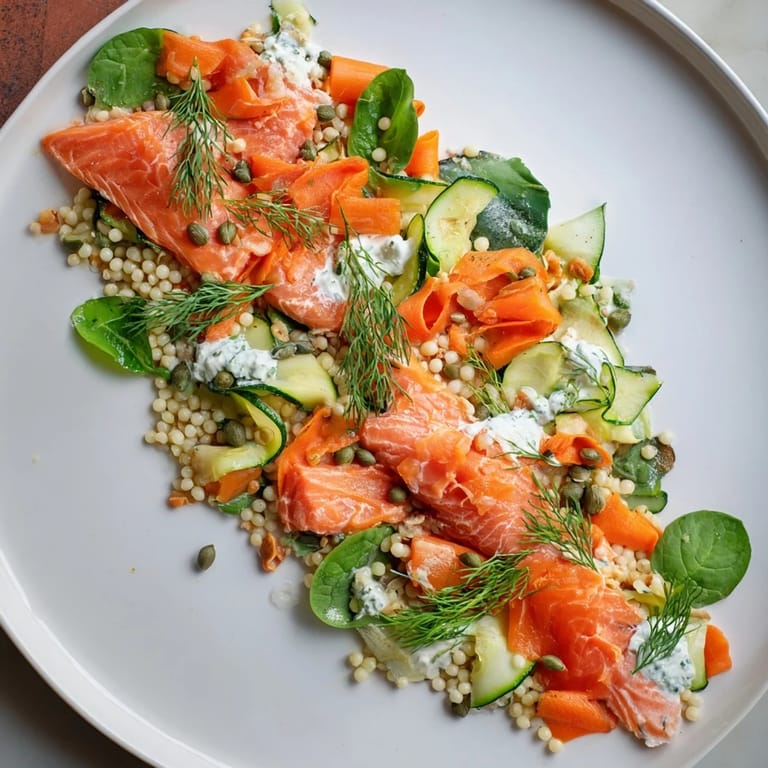
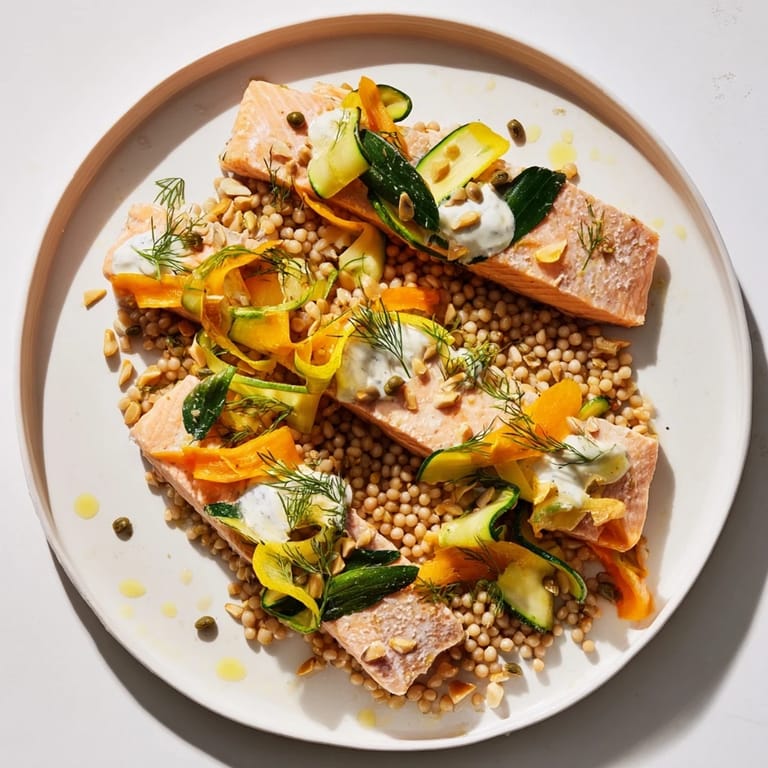
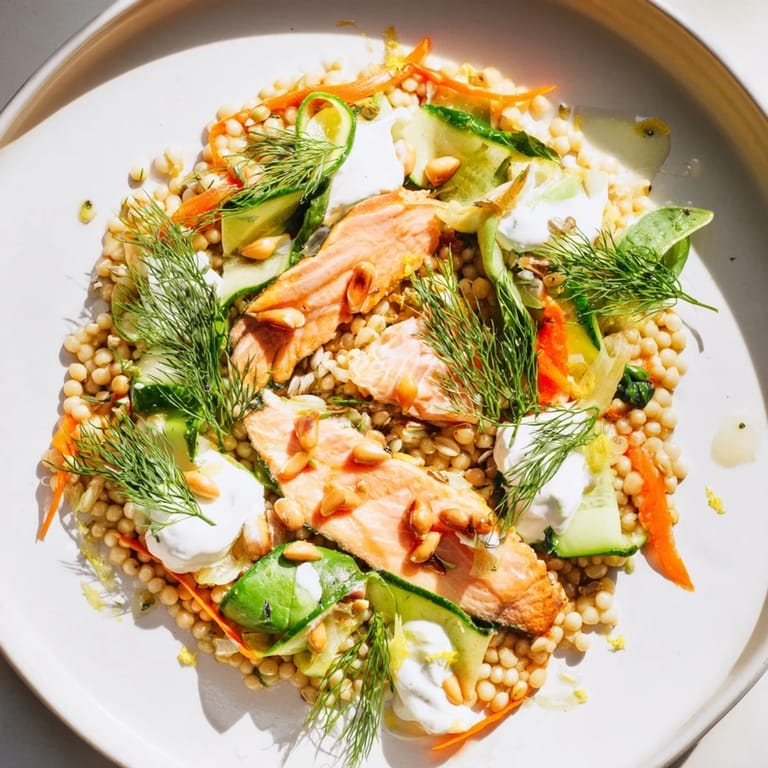
- This is the moment everything comes together. Using the cooled couscous as your guide, spoon it into a smooth figure-eight pattern directly on your platter. Now, as if you're painting, arrange your blanched vegetables in an alternating pattern along the loop—a line of zucchini, then carrot, then fennel, then spinach. Let the colors speak. Nestle your beautiful salmon flakes into the curves where they belong. Dot small spoonfuls of your yogurt dressing throughout. Scatter capers sparingly across the entire design. Finish with your toasted pine nuts sprinkled like tiny jewels.
- Serve with attention:
- Bring this to the table while everything is still cool but not cold. Serve immediately, encouraging people to follow the loop as they eat, experiencing how each ingredient leads to the next. The temperature, the arrangement, the colors—it all matters.
 Save
Save What stays with me about this dish is how it transforms a table. People come to eat, but they arrive at a moment. They pause. They photograph it. They discuss how to eat it. That's when a recipe stops being instructions and becomes something you've shared with people you care about. The Infinity Loop Flow stopped being 'what I made' and started being 'that beautiful thing she always makes.'
The Art of Thin Slicing
I've discovered that a mandoline slicer is genuinely worth having in your kitchen, especially for vegetables that need to be paper-thin like zucchini and carrot. Without one, a very sharp knife and patience work, but there's a difference in consistency and beauty. The goal is uniform slices thin enough to be tender but thick enough to hold their shape and color. When I started using a mandoline, my vegetable arrangements went from looking homemade to looking intentional. It's a small investment that matters for dishes like this where presentation is part of the pleasure.
Why Temperature Control Matters Here
This is a dish meant to be served cool or at room temperature, which means you need to plan your timing carefully. Everything needs to be cooled before plating so the components don't wilt or warm each other. I used to plate while things were still warm, and the couscous would absorb the vegetable moisture, creating a muddy appearance. Now I cool everything thoroughly, and the integrity of each element shines through. It's also why serving it immediately after arranging is important—the longer it sits, the more the textures start to communicate with each other, and you lose that clean, distinct feeling.
Making It Your Own
The beauty of the infinity loop concept is that it's a framework for your own creativity. I've made versions with roasted radish slices for a peppery pop, or thin beet slices for deeper color. Some seasons I add a very thin slice of fennel frond for extra herbaceousness. The dressing can shift slightly—sometimes I use crème fraîche instead of Greek yogurt, or add a tiny bit of Dijon mustard for sophistication. The core principle stays the same: alternating colors, building flavors, letting each element shine. These are the experiments that make cooking feel like play instead of obligation.
- Substitute trout or cod for salmon if that's what's fresh at your market—the technique remains the same.
- For a vegetarian version, replace salmon with thick slices of baked tofu or even roasted mushrooms, adjusting cooking time slightly.
- A crisp Sauvignon Blanc or light-bodied Pinot Gris is what I always reach for, but any bright, mineral white wine will feel right beside this dish.
 Save
Save Every time I make The Infinity Loop Flow, I'm reminded that the most elegant dishes are often the ones that feel like a gift to the people eating them. This one always delivers that feeling.
Recipe Questions
- → How do I achieve the figure-eight presentation?
Begin by shaping cooked couscous into a continuous figure-eight on a large platter, then arrange the vegetables and salmon flakes along the curves to emphasize flow.
- → Can I substitute the salmon with another fish?
Yes, trout or cod can be used as alternatives, offering similar textures and flavors suited to this preparation.
- → What is the best way to cook the pearl couscous?
Simmer the pearl couscous in vegetable broth for about 10 minutes until tender, then fluff with a fork to avoid clumping.
- → How should the vegetables be prepared for optimal texture?
Blanch zucchini, carrot, and fennel slices quickly in boiling water, then cool in ice water to preserve color and crispness.
- → What garnishes add the most flavor impact?
Fresh dill, lemon zest, capers, and toasted pine nuts provide bright, tangy, and crunchy accents that elevate the dish’s complexity.